
Four of the six pairs on our top picks page are clusters rather than strips. If you have only ever worn a strip lash, that is a meaningful difference, and the product listings tend not to explain it.
Clusters are not strips cut into pieces.
They go somewhere else on your eye, they use a different adhesive, and they fail in a different way when they go wrong.
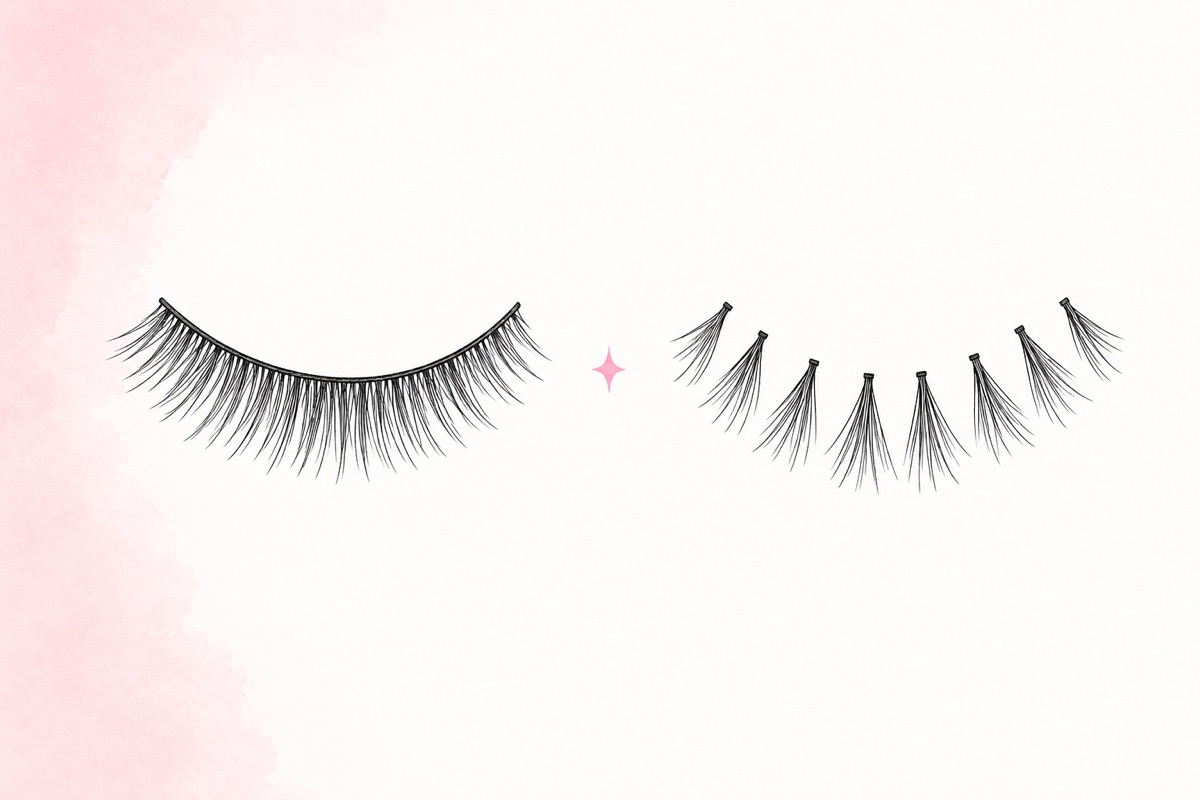
The short version
| Strip lashes | Lash clusters | |
|---|---|---|
| Where it attaches | On top of the lash line | Underneath your own lashes |
| Adhesive | Lash glue | Bond plus sealant |
| Wear time | One day | Three to seven days |
| Application | One placement per eye | Ten to twelve per eye |
| Removal | Peel off at night | Dissolve with remover |
| Learning curve | An evening | Two or three attempts |
What a strip lash actually is
One continuous band with lashes attached along it. You put glue on the band, wait for it to go tacky, and lay it along your lash line.
It sits on you, not in you.
That is why a strip is forgiving. If the placement is wrong you lift it off and try again, and at the end of the night the whole thing comes away in one piece. It is also why a strip has a visible band, which is its own problem to solve, covered in hiding a false lash band.
A strip is a daily decision. You are not committed past bedtime.
What a cluster actually is
A small fan of lashes, usually six to fourteen hairs, bonded at a single point rather than along a band. A tray holds a hundred or more in mixed lengths.
The critical part: clusters attach underneath your natural lashes, not on your eyelid.
You put a drop of bond on the cluster's knot, slide it under your own lash line from below, and press it against your natural lashes so it grips the hair rather than the skin. Then a sealant goes over the top to lock it.
This is the step people get wrong. If you apply a cluster the way you apply a strip, flat onto the lid, you glue it to skin that moves every time you blink, and it will tug.
The adhesive is not the same thing
Strip glue is designed to hold for a day and release when you want it to.
Cluster bond is designed to survive sleeping, showering and washing your face for most of a week. It comes as two bottles:
- Bond goes on the cluster before it touches your lashes
- Sealant goes over the join afterwards, from underneath and above
Using strip glue with clusters is the single most common mistake. It will hold for a few hours and then start releasing one cluster at a time, usually in public.
Kits that bundle all of it solve that. The AMZGIRL cluster set includes bond, seal, remover and an applicator, which saves buying three bottles separately and finding out one of them is the wrong type.
Which one suits you
Pick strips if:
- This is your first pair of false lashes
- You want the look for one event
- You wear lashes occasionally rather than weekly
- You want to take them off whenever you like
- You are still working out what length and curl suit your eye
Pick clusters if:
- You want to wake up with lashes on
- You wear falsies several times a week and the nightly routine has worn thin
- You want to vary length across the eye, short at the inner corner and long at the outer
- You are comfortable working close to your lash line with a tool
- You have the patience for a learning curve
That last point is not a throwaway. A first cluster set takes most people forty minutes and comes out uneven. The second takes twenty. After that it is faster than you would expect.
The B&Q Fairy clusters use a thinner band than most, which is more forgiving if a cluster lands slightly off, and that makes them an easier place to start than a heavier tray.
Where clusters go wrong
Applied to skin. The symptom is a tugging feeling and a cluster that lifts at one end within a day. The fix is placement, not more bond.
Too many, too close. Clusters sitting on top of each other read as a solid wall rather than a fringe, and the weight pulls. Leave a small gap between each one.
Pulled off dry. This is where damage happens. The bond is stronger than your natural lash, so if you pull, the lash comes with it. Every kit includes remover for a reason.
Worn past their point. Around day five or six the bond starts to loosen as your natural lashes grow out. That is the signal to remove them, not to add more bond on top.
Where strips go wrong
Mostly fit. A strip that is too long for your eye lifts at the corners, pokes the inner corner, or both. That is fixable with trimming and is worth doing before you ever open the glue.
If yours lift no matter what, there is a longer list of causes in why false lashes keep lifting.
Can you use both?
Yes, and plenty of people do.
Strips for a one off, clusters for a stretch where you want lashes every day without the nightly routine. They are not competing products so much as two different time commitments.
If you are specifically after the spiky manga look, the format matters less than the spike pattern, which is covered in manga lashes. Both formats are sold in spiky cuts.
For the lower lash line, clusters have a clear edge, because a lower strip is difficult to place well. That is covered separately in anime lower lashes.
Start here
If you are undecided, buy a strip.
Not because strips are better, but because a strip teaches you what you need to know to buy clusters well: how long your eye actually is, which curl suits your lid, and whether you prefer weight at the centre or the outer corner.
That knowledge transfers. A wasted cluster tray does not.